
How long does SEO take? Here is the honest timeline.
Anyone who promises page one in thirty days is guessing or gaming. Here is how a real campaign unfolds, and the engineering choices that make it faster.
SEO usually takes three to six months to show meaningful movement and six to twelve months to compound, depending on competition, the site's technical health, its authority and how consistently work is done. Fixing technical blockers first shortens the timeline.
Most Denver engagements show meaningful traction in months 3 to 4, sustained measurable results in months 6 to 9, and compounding category authority by month 12. Specifically, AI search visibility can move faster than classical Google rankings when schema and citation-ready content are in place from day one.
From Foundation to Compounding Authority.
Specifically, every well-executed Denver SEO engagement follows the same four-phase progression. Furthermore, the timeline below reflects realistic expectations from 24 years of agency-side experience, not optimistic sales-pitch projections.
Get Your Free Timeline-Specific Audit.
60 seconds. No commitment. Specifically, we will show you exactly which phase of the timeline your business is currently in, what it would take to compress your time-to-results, and a custom 90-day plan to start the momentum phase. Senior strategist response within one business day.
- Phase diagnosis based on your current state
- Realistic timeline aligned to your category competitiveness
- Time-to-results acceleration opportunities
- Custom 90-day priority roadmap
Fast lane. Strategist response, typically within 1 business day.
Specifically, most Denver engagements show first meaningful traction in months 3 to 4, sustained measurable revenue impact in months 6 to 9, and compounding category authority by month 12. Furthermore, AI search visibility (citations in AI Overviews, ChatGPT, Perplexity) can move faster than classical Google rankings when schema and citation-ready content are deployed from day one. Above all, agencies promising results in 30 to 60 days are typically misrepresenting either the timeline, the work, or both.
Foundation Phase
Specifically, the first two months are about diagnosis and infrastructure, not visible ranking gains. Furthermore, agencies that skip this phase to chase early ranking wins typically deliver weaker results across the rest of the engagement. Above all, foundation work compounds throughout the rest of the year.
- Comprehensive technical and content audit against current state and competitors
- Schema architecture design across LocalBusiness, Service, FAQPage, BreadcrumbList types
- Keyword and conversational query landscape mapping for both classical and AI search
- Citation and authority gap analysis across priority AI engines
- Conversion path audit for both human and agentic visitors
- 90-day priority roadmap with measurable phase-1 targets
Build Phase
Specifically, months 3 and 4 deploy the foundation work into production. Furthermore, the first meaningful ranking and citation traction typically appears in this window for less competitive categories. Above all, this is when the engagement starts producing visible signals that the work is moving.
First ranking improvements + initial AI citation appearances.
- Citation-ready content deployment on priority pages and topics
- Schema rollout across the site including @graph implementation
- Authority signal development through expert authorship and original research
- Selective high-quality link earning from genuinely relevant publications
- Conversion engineering rollout including agent-readability fixes
- First citation tracking baselines across priority AI engines
Momentum Phase
Specifically, months 5 through 7 are when the cumulative foundation and build work begins producing measurable revenue impact. Furthermore, this is the window where ranking improvements translate to organic leads and AI citations translate to qualified inbound interest. Above all, this is the inflection point where SEO ROI becomes visible to leadership.
Revenue-relevant traffic growth + measurable lead attribution.
- Sustained ranking gains on commercially valuable keywords
- AI citation share reaches measurable levels across priority engines
- Lead and revenue attribution emerges in dashboards
- Long-tail visibility compounds as topical authority develops
- Featured snippet and answer-box appearances begin
- Brand search volume starts trending up as authority establishes
Compounding Phase
Specifically, months 8 through 12 are when the engagement starts producing returns disproportionate to the ongoing monthly investment. Furthermore, the work done in months 1 through 7 continues delivering value with no incremental cost. Above all, this is the phase that explains why patient SEO outperforms paid acquisition over multi-year horizons.
Compounding returns, durable category visibility, defensible position.
- Compounding ranking strength across the keyword landscape
- Sustained AI citation share in priority engines for category queries
- Cost per lead from organic drops below paid acquisition
- Brand becomes the default reference for adjacent queries in the category
- Defensible competitive position harder for new entrants to displace
- Continuous improvement on the foundation rather than rebuilding it
Indexed curve representing typical organic visibility progression. Specific results vary by category competitiveness, starting state, and budget.
- Lower-competition local categories. Niche professional services in Denver suburbs see traction faster than competitive metro categories.
- Strong existing domain authority. Established sites with clean histories get indexed and trusted faster.
- Comprehensive starting schema. Sites already running solid structured data accelerate citation work.
- Original research and proprietary data. High-value content earns citations faster than generic content.
- Verifiable expert authorship. Real credentials and authority signals shorten the trust-building timeline.
- Healthy conversion infrastructure. Frictionless forms and pricing transparency convert traffic faster.
- Recency-friendly content cadence. Consistent publishing rhythm speeds up engines like Grok and AI Overviews.
- Highly competitive verticals. Denver legal, medical, and financial categories require longer competitive ramps.
- Penalty recovery situations. Sites with prior manual actions or aggressive backlink profiles need cleanup before growth.
- Brand new domains. Domains under 12 months old face additional trust thresholds.
- Weak existing content foundation. Sites starting with thin or generic content need longer build phases.
- Limited budget for foundation work. Underinvesting in months 1-2 extends every subsequent phase.
- Complex technical migrations. Replatforms or major architecture changes require longer stabilization windows.
- Multi-location complexity. Multi-city or multi-service-area businesses need longer to build coverage.
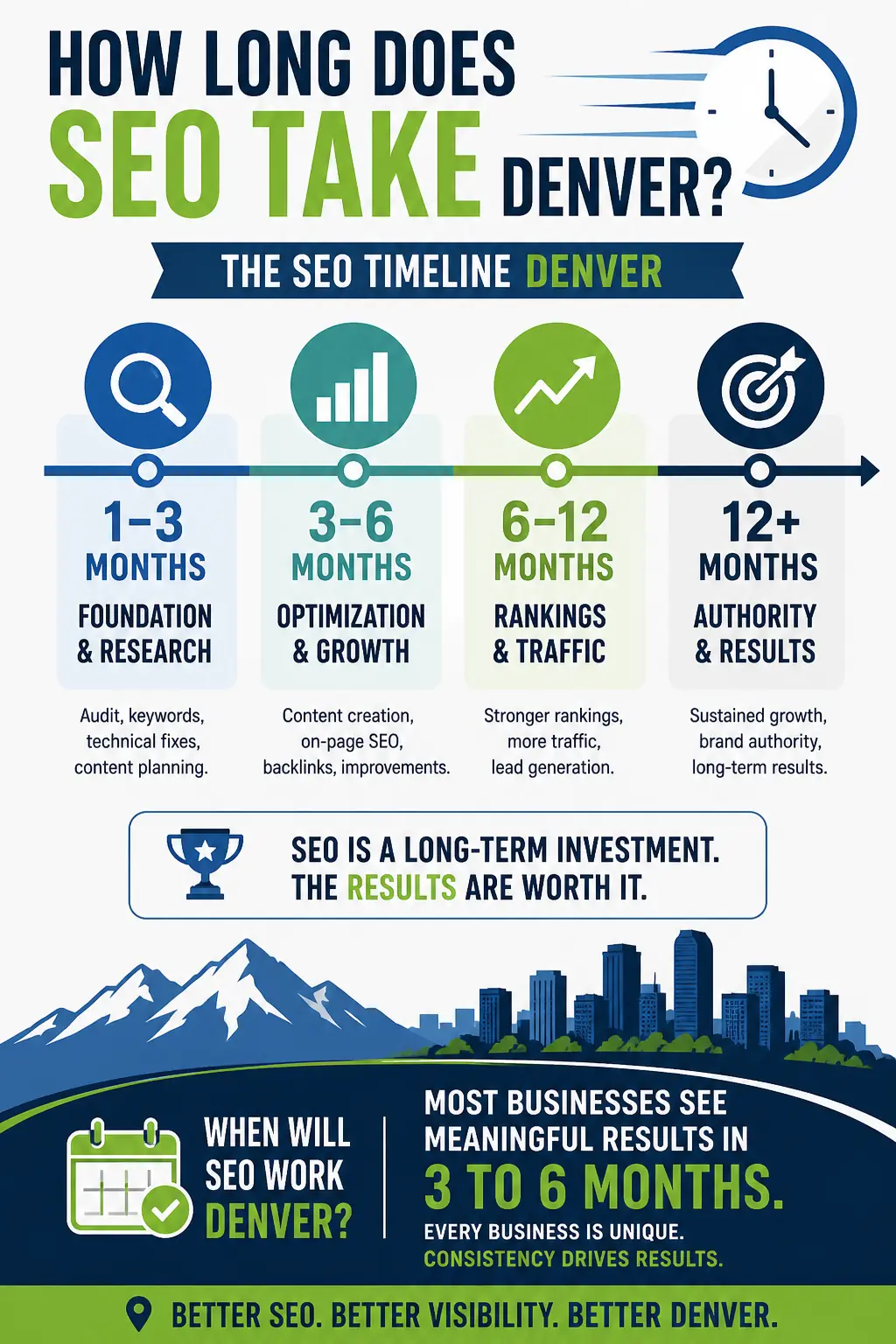
Use The Timeline as a Calibration Tool
Specifically, the visual above is calibrated against 24 years of agency-side experience in Denver across professional services, ecommerce, B2B SaaS, and local consumer categories. Furthermore, the four-phase framework holds across these verticals even though the specific month-by-month outcomes vary.
Above all, if your current SEO agency cannot articulate which phase you are in, what work is happening to advance you, and what the next-phase markers look like, that is itself a diagnostic signal. As a result, see our why most Denver SEO fails page for the full failure-mode framework.
For the broader strategic context on how AI search is reshaping these timelines specifically, our how AI is changing SEO thesis covers the structural shifts. For the master tactical playbook covering all 9 AI search engines, see Denver AI SEO.
GAI OverviewsGoogle's generative answer surface CChatGPTThe conversation engine PPerplexityThe research engine AClaudeThe analytical engine MGeminiThe hybrid signal engine XGrokThe real-time engine NManusThe agentic engine +All 9 EnginesMaster playbook
Where this connects
Eye To Ad Media also walks through the first 90 days of SEO month by month.
Where Are You On The Curve?
Get a comprehensive timeline diagnostic. Specifically, we will identify which phase your business is currently in, where the bottlenecks are, what would compress your time-to-results, and the prioritized 90-day plan to advance you to the next phase. Senior strategist response within one business day.
- Current phase diagnosis with evidence
- Time-to-results acceleration analysis
- Multi-engine AI search visibility audit
- Competitive timeline benchmarking
- Custom 90-day phase-advancement roadmap
Senior strategist response within one business day. Real eyes, real analysis.
Questions, answered straight
How long does SEO take in Denver?
Most Denver SEO engagements show meaningful traction in months 3 to 4, sustained measurable revenue impact in months 6 to 9, and compounding category authority by month 12. Specifically, AI search visibility (citations in AI Overviews, ChatGPT, Perplexity) can move faster than classical Google rankings when schema and citation-ready content are deployed from day one. Above all, agencies promising results in 30 to 60 days are typically misrepresenting either the timeline, the work, or both.
When will SEO start working for my Denver business?
First meaningful traction typically appears in months 3 to 4 of a properly executed engagement. Specifically, this is when content + schema + initial citation work reach indexing maturity and engines begin treating the new signals as trustworthy. Furthermore, the inflection point where SEO ROI becomes visible to leadership typically arrives in months 5 to 7.
Why does SEO take so long?
SEO operates on compounding returns where front-loaded foundation work (audit, schema, content infrastructure) builds the substrate for everything that follows. Specifically, search engines must crawl, index, evaluate, and trust new signals before they translate to ranking and citation gains. Furthermore, the trust-building process cannot be shortcut without risking penalties that extend the timeline rather than compress it.
Can SEO results happen faster than 3 months?
Specifically, faster results are possible in three scenarios: lower-competition local categories, sites with strong existing domain authority and clean histories, and specific high-intent low-competition keyword opportunities. Furthermore, AI search citations can sometimes appear within weeks of strong original content publication. Above all, faster-than-3-month results across the entire engagement remain rare regardless of agency promises.
What is a realistic SEO timeline for a new Denver website?
For brand-new domains under 12 months old, the realistic timeline extends 2-3 months beyond standard expectations because new domains face additional trust thresholds. Specifically, foundation work runs through month 3, build phase through month 5, momentum through month 9, and compounding starts month 10. Above all, new sites benefit from front-loaded content quality and schema implementation more than from aggressive link building.
How long does local SEO take in Denver?
Local SEO in Denver typically moves faster than competitive national SEO. Specifically, Google Business Profile optimization, local citation cleanup, and review velocity work can show map pack movement within 2 to 4 months. Furthermore, less competitive Denver suburbs and niche local categories sometimes see meaningful local pack improvements within 60 days. Above all, the 6 to 9 month sustained results window still applies for revenue impact.
How long does AI SEO take?
AI search visibility (citations in AI Overviews, ChatGPT, Perplexity, Claude, Gemini) can move faster than classical Google rankings. Specifically, well-engineered citation-ready content with comprehensive schema can appear in AI engine answers within 30 to 90 days. Furthermore, AI Overviews particularly favor sites with strong existing rankings, so AI Overview presence often correlates with classical SEO maturity rather than appearing independently.
What should I see in the first 90 days of SEO?
In the first 90 days you should see comprehensive technical and content audits completed, schema architecture deployed, content production rolled out, citation work begun, and initial indexing of new content. Specifically, you should NOT expect significant ranking improvements or revenue impact yet. Above all, the deliverable in months 1 to 3 is infrastructure and momentum, not visible business results.
How do I know if my SEO is on track?
Specifically, on-track engagements show: comprehensive deliverables in months 1 to 2, content and schema deployment in months 3 to 4, first ranking and citation traction visible in months 4 to 5, measurable lead attribution beginning in months 5 to 7, and clear revenue impact by months 7 to 9. Furthermore, if month 6 looks identical to month 1 in terms of traffic, rankings, and citations, the engagement is failing. See our why-most-Denver-SEO-fails framework for the full diagnostic.
Should I cancel SEO if I don't see results in 6 months?
Specifically, the answer depends on what 'results' means. Furthermore, by month 6 you should see foundational infrastructure complete, initial ranking and citation traction visible, and early lead attribution emerging. Above all, if those markers are absent at month 6, the engagement is failing and earlier conversation is warranted. However, expecting full revenue ROI at month 6 is typically premature for competitive Denver categories.
Why do SEO agencies promise faster results?
Specifically, agencies promise faster results because faster-results promises close more sales, even when those promises are not deliverable. Furthermore, agencies that operate on volume and short engagements have structural incentives to oversell timelines and underdeliver outcomes. Above all, any agency promising specific rankings in 30 to 60 days is either inexperienced or dishonest — see our why-most-Denver-SEO-fails framework for the full pattern.
Does Denver SEO take longer than other cities?
Denver SEO timelines are similar to other major US metros for comparable categories. Specifically, Denver legal, medical, and financial services run on similar competitive timelines to Austin, Seattle, or Charlotte. Furthermore, what matters more than the city is the category competitiveness, the starting state of the website, and the budget allocated to foundation work in the first 90 days.
Can I speed up Denver SEO with a bigger budget?
Specifically, larger budgets compress timelines but cannot eliminate the foundational work that has to happen sequentially. Furthermore, the right budget question is whether you have enough budget to do the work properly through month 6 before expecting ROI, not whether you can spend more to get faster results. Above all, properly funded foundation work in months 1 to 2 produces faster total results than aggressive paid acquisition substituting for SEO infrastructure.
How long until SEO pays for itself?
Specifically, well-executed Denver SEO typically pays for itself by months 9 to 12 for B2B and professional services categories, and by months 6 to 9 for higher-velocity consumer categories. Furthermore, the compounding phase from month 12 onward is where SEO produces returns disproportionate to ongoing monthly cost. Above all, paid acquisition produces immediate ROI but does not compound, while SEO produces delayed ROI that compounds for years.
What is the right way to evaluate Denver SEO progress?
Specifically, evaluate progress against phase-appropriate markers: Foundation phase (M1-2) by deliverable completion, Build phase (M3-4) by content and schema deployment plus first traction, Momentum phase (M5-7) by ranking gains and lead attribution, Compounding phase (M8-12) by revenue impact and category authority. Furthermore, ranking-only evaluation misses the actual progress. Above all, evaluate based on the phase you are in, not the phase you wish you were in.
Not everyone should hire us. Let's find out if you should.
A quick, honest conversation. If it's not a fit, we'll point you somewhere better.