For 24 years, SEO meant winning a single contest on a single engine. Today it means earning citations across nine surfaces, surviving multi-step agent evaluations, and engineering pages for readers who are increasingly software, not human. This is the complete thesis on what changed, what is coming, and what your business should do about it.
The search landscape did not change gradually. It hinged sharply on a few specific moments. Here is the timeline that explains why every business now needs a portfolio strategy, not a Google strategy.
60 seconds. No commitment. Specifically, we will show you exactly how your business currently appears across nine AI search surfaces, where competitors are gaining citation share, and the priority moves to capture visibility before your category reorganizes around the new winners. Senior strategist response within one business day.
This is the authoritative thesis page for the entire DenverSEO.io network. Specifically, every other page in our system documents tactical execution against a specific surface: Denver AI SEO covers the master playbook, AI Search Optimization Denver covers the four-stage mechanics, and Google AI Overviews SEO, ChatGPT Search Optimization, Perplexity SEO, Claude AI SEO, Google Gemini SEO, Grok SEO Denver, and Manus AI SEO Denver each cover the specific surface they target. This page tells you why those pages exist. This is the strategic context. The other pages are the implementation.
Most paradigm shifts unfold over a decade. Specifically, this one mostly unfolded between November 2022 and May 2026 — about 42 months. ChatGPT crossed 100 million users faster than any consumer product in history. Perplexity went from a side project to a billion-dollar valuation in under three years. Google launched AI Overviews and reorganized its results page around AI generation. As a result, the search behavior change is not coming. It already happened. Most agencies have not caught up because they were optimizing for last decade's contest while the rules quietly rewrote themselves.
This page lays out five paradigm shifts that explain almost every change you are seeing, a side-by-side comparison of AI search vs traditional SEO across five strategic dimensions, the concrete list of what dies and what survives, four specific predictions through 2030, and a summary of what businesses should do right now. Above all, this is meant to be the document you forward to leadership when you need to explain why AI SEO investment matters this year, not next year.
Each shift below represents a permanent reorganization of how visibility, trust, and conversion work online. Specifically, you cannot opt out of these shifts by working harder on the old playbook. Above all, the businesses that internalize them first capture compounding advantages.
Specifically, the goal is no longer "rank first on Google" but "get cited inside the AI answer that replaces the ranking." Therefore, the metric that matters is citation share across answer engines, not blue-link position. Furthermore, citation share compounds because cited brands become the default reference for adjacent queries.
Specifically, search is now a portfolio. Google AI Overviews, ChatGPT, Perplexity, Claude, Gemini, Grok, Manus, traditional Google Search, and emerging agentic platforms each have distinct optimization mechanics. As a result, single-engine strategies leave 50 to 70 percent of category visibility on the table. The right frame is engine-portfolio thinking.
Specifically, users no longer type "denver seo agency." They type "I run a Denver dental practice and need help getting found in AI search, what should I do?" Therefore, the optimization unit is no longer the keyword but the conversational query landscape. As a result, content built for natural language patterns and entity relationships outperforms keyword-stuffed pages decisively.
Specifically, AI engines do not cite pages, they cite passages. Therefore, the unit of optimization is the well-structured 60 to 100 word passage that answers a specific question with concrete substance. Furthermore, pages built as collections of citable passages outperform pages built as keyword-optimized prose. Citation-ready writing is now a craft skill, not a content production task.
Specifically, agentic platforms like Manus do not generate visits, they complete tasks. Therefore, the conversion event shifts from "user clicks and then converts" to "agent selects and acts." As a result, businesses with frictionless conversion infrastructure win agent action share. Hidden pricing, broken forms, and unclear CTAs eliminate businesses from agentic shortlists silently.
Specifically, the comparison below maps five strategic dimensions where the old discipline and the new discipline diverge. Click each tab to see the side-by-side detail. Above all, this is the comparison you need to internalize if you are still operating on the old playbook.
User typed a keyword, Google returned ten blue links, user scanned and clicked. Specifically, position 1 to 3 captured roughly 60 percent of clicks. Therefore, optimization centered on outranking competitors for a finite list of high-value keywords.
User asks a conversational question, AI generates a synthesized answer with one to four citations. Specifically, only the cited brands get visibility, and the cited list is often shorter than the old ranked list. Therefore, optimization centers on becoming one of the few cited sources for thousands of variant queries.
Search engines inferred trust primarily from inbound link profiles. Specifically, high-authority backlinks were the dominant signal of credibility. Therefore, link building dominated SEO budgets and tactics for two decades.
AI engines evaluate entity authority, expert credentials, organizational reputation, content depth, and verifiable expertise. Specifically, the brand becomes a trusted entity in a knowledge graph rather than a domain in a link graph. Therefore, real expertise and verifiable authority signals outperform link manipulation decisively.
User clicked through to a landing page, browsed the site, evaluated the offer, and converted manually. Specifically, every conversion required a human visit. Therefore, page experience optimization centered entirely on human readers.
Increasingly, the user's agent completes the conversion without the user ever visiting the site. Specifically, the agent reads schema, evaluates pricing, selects a provider, and submits the form autonomously. Therefore, optimization must serve agents and humans simultaneously, with the same friction reductions benefiting both.
Specifically, dashboards tracked keyword rankings, organic sessions, click-through rates, and goal completions. Therefore, success was measurable but tied to a narrow contest.
Specifically, AI search measurement tracks citation share across engines, query coverage, agent action completion rates, and AI-attributable revenue. Therefore, the dashboards look fundamentally different and require new tooling. As a result, agencies still showing only ranking reports are operating with old instruments in a new world.
Budgets flowed primarily to link building and high-volume content production. Specifically, success often correlated with budget size and execution discipline. Therefore, well-funded brands dominated competitive categories.
Specifically, budgets shift toward schema engineering, citation-ready content craft, agent-readiness optimization, and verifiable authority development. Therefore, smaller well-engineered brands can outperform larger but unengineered competitors. As a result, this is the rare moment where strategic positioning beats raw spend.
Specifically, the chart below tracks how share of all consumer search activity migrates from Google-only into a multi-engine reality. Above all, the projection lines for 2028 and 2030 reflect current trajectories, not speculation. The trend is unmistakable.
Specifically, Google share is not collapsing — it is fragmenting. Furthermore, by 2030, less than 40 percent of consumer search activity is projected to occur on Google's traditional surface. Therefore, businesses with single-engine strategies are positioning themselves to lose roughly 60 percent of category visibility over the next 48 months.
As a result, the right strategic response is not abandoning Google but expanding into a portfolio. Above all, the engines you choose to optimize for should match where your audience is actually researching. For most B2B and professional services audiences, Perplexity and Claude already exceed Google on relevant query intent.
Specifically, the infographic below summarizes the entire transformation in a single shareable visual. Above all, this is the asset to forward to leadership when explaining why AI search optimization is a 2026 priority, not a 2027 question.
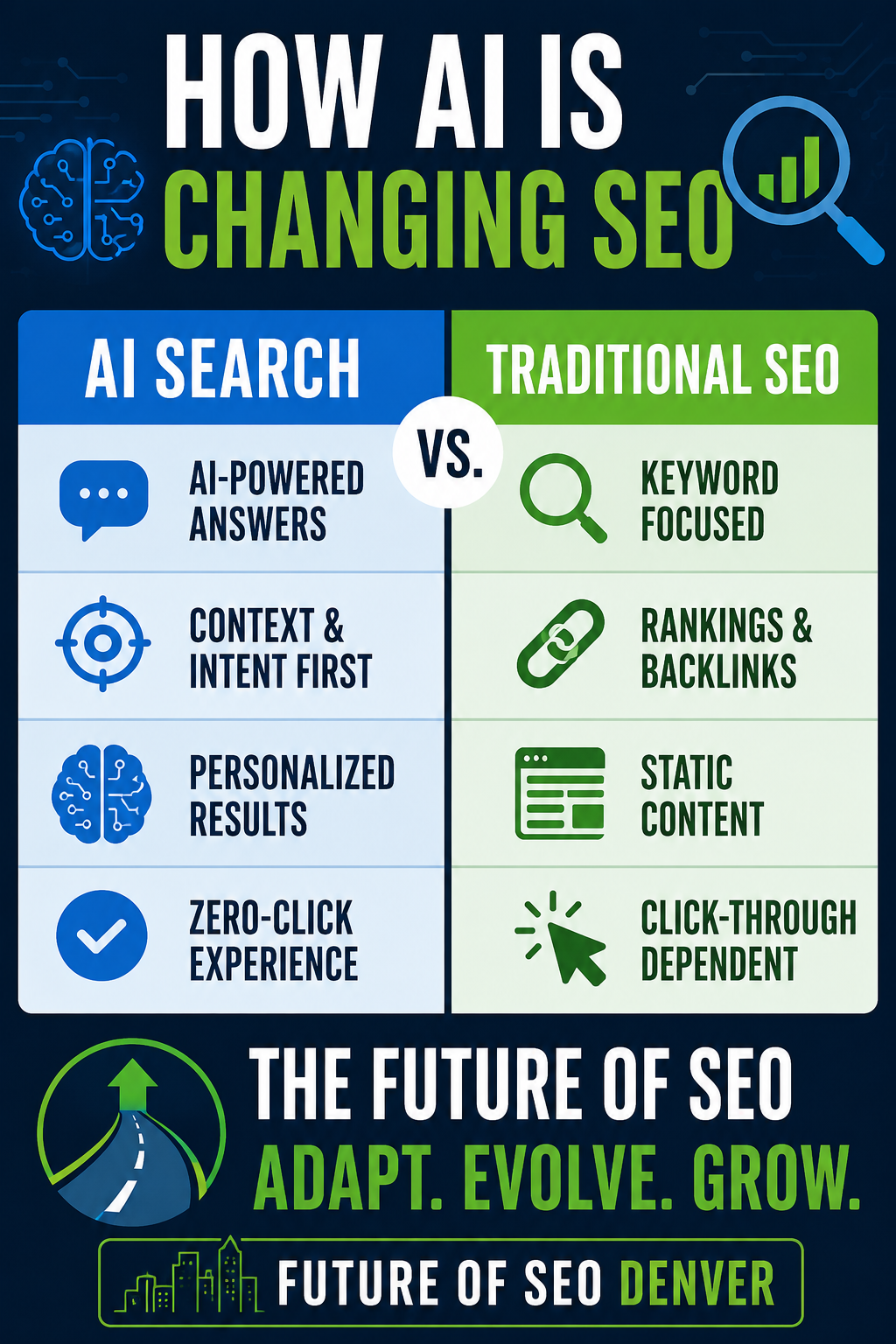
Specifically, the transformation is large enough that prose alone struggles to make it concrete. Furthermore, the infographic gives leadership a single shareable artifact that captures the full scope of the shift in the time it takes to scan a slide. Therefore, our clients use it in board presentations, investor updates, and internal strategy memos.
The diagnostic question this image answers is simple: which side of this transformation is your current SEO investment funding? Above all, businesses still funding the left side of the diagram while the world moves to the right side will see compounding visibility losses over the next 24 months.
Pair this with our Denver AI SEO master playbook and the underlying mechanics of AI search optimization to get from understanding to execution.
Specifically, not everything about traditional SEO is obsolete. Furthermore, some classical disciplines become more important than ever. Above all, the businesses that win the next decade are the ones that correctly identify what to abandon and what to double down on.
Specifically, these are not hedged forecasts. Furthermore, each prediction comes with a date and a rationale. Above all, we are willing to be wrong publicly because we believe the trajectory is clear enough to commit to specific calls.
Specifically, ChatGPT, Perplexity, Claude, and AI Overviews are already eating early-funnel research behavior. Therefore, by 2027, the majority of commercial intent will originate inside an AI conversation, not a search box. Businesses without AI citation strategies will see early-funnel demand drop measurably.
Specifically, B2B procurement, vendor research, and shortlist generation increasingly delegates to autonomous agents. Therefore, businesses without agent-ready optimization fall out of consideration sets they used to win. Schema, pricing transparency, and frictionless forms become procurement infrastructure, not marketing tactics.
Specifically, position tracking already feels increasingly disconnected from business outcomes for AI-mature categories. Therefore, by 2029, citation share, AI action completion, and AI-attributable revenue dominate dashboards. The agencies still selling rank reports will look like agencies selling fax services in 2010.
Specifically, local intent queries increasingly route through autonomous agents that book appointments, request quotes, or complete purchases on behalf of users. Therefore, local SEO becomes inseparable from agent-ready optimization. The local businesses winning Denver in 2030 will be the ones who treated agent-readiness as core infrastructure starting now.
Specifically, here is what every business should do in the next 90 days regardless of size, vertical, or current SEO maturity. Above all, these are the moves that compound across every AI engine and protect against the full range of paradigm shifts described above.
DenverSEO.io is operated by Eye To Ad Media, Denver's leading authority on AI search. Specifically, two decades of multi-channel marketing discipline plus deep AI search practice across nine engines give us the strategic and tactical capability to navigate this transition end-to-end. Furthermore, the Eye To Ad Media Ad Lab showcases the kind of distinctive creative work that earns attention in any era. Meet the team who actually does the work, and visit our Denver SEO authority homepage for the complete service catalog. For paired conversion engineering by an experienced Denver web designer team, our sister agency Search Converts handles full-funnel execution.
Specifically, here is the complete map of AI search surfaces we currently track and optimize. Each link goes to the specific tactical playbook for that engine. Above all, the right strategy is not picking one but choosing your priority portfolio based on where your audience actually researches.
Specifically, the businesses winning AI search in Denver and beyond are not the ones with the biggest budgets. Furthermore, they are the ones who internalized the paradigm shift first and rebuilt their optimization discipline around it. Above all, this is the rare moment in SEO history where strategic clarity beats raw spend.
If you take one thing from this page: the fragmentation of search across nine engines is not a risk to manage but an opportunity to capture compounding visibility before your category reorganizes around the new winners. Therefore, the businesses who move now will be the cited brands when their slower competitors finally catch up.
Quick answers to the questions Denver business owners and marketing leaders ask most often about the AI search transformation, what to do about it, and what to expect over the next five years.
Get a comprehensive AI search audit. Specifically, we will show you exactly how your business currently appears across nine AI search surfaces, where competitors are gaining citation share, where conversion friction blocks agent selection, and the prioritized 90-day plan to capture visibility against named competitors before your category reorganizes around the new winners.